
Running a Community-led Participatory Budgeting Process
A Step-by-Step Handbook to Help You Plan,
Train, and Bring Everyone Together
About This PB Handbook
Welcome, and congrats on embarking on this journey to engage your community in real decision-making! This handbook is intended to help usher anyone who is getting ready to implement a participatory budgeting (PB) process through the goals, key considerations, training needs, and best practices to plan and carry out each phase of PB. Since 2009, the Participatory Budgeting Project has supported 85% of PB processes in the United States 1. This guide captures the learnings we have collected as we supported cities and institutions across North America in designing and implementing their own community-led PB process.
PB is a multi-step process that brings together community members, local organizations, and various government or institutional departments, each playing a vital role throughout the different phases. This handbook takes the guesswork out of launching a carefully planned, accessible PB process by clearly outlining the key decisions you’ll need to make at every stage. It also provides the training resources necessary to set your collaborators up for success. At the end of each chapter you will find customizable tools and templates to help you carry out every part of the process. Think of this handbook as your PB coach who is guiding you and supporting you as you plan and bring each phase to life.
How To Use This Handbook
Chapters
This handbook is your step-by-step companion through the PB process, organized into six themed chapters. Most chapters follow the main phases of PB, walking you through what to plan, how to put it into action, and the training needed to make it run smoothly.
You can jump into any chapter that’s most relevant to you, but we recommend starting with “Preparing for PB”. Think of it as your launchpad as it covers the big-picture decisions and prep work you’ll want to do before getting started, along with any phase-specific tasks you might need to tackle ahead of time.
For chapters focused on a specific phase, you’ll find a “Looking Ahead” section at the end. These give you a heads-up about what’s coming next, so you can start preparing before the next phase officially begins.
Here’s a quick preview of what each chapter holds:
Introduction to PB And This Handbook
This chapter welcomes you to the handbook and shares practical tips for making the most of it. You’ll also get a clear introduction to Participatory Budgeting - its history, goals, and values, along with an overview of the key roles different stakeholders play in the process.

Preparing for PB: Building Your Infrastructure, Resources, & Community Support
This section walks you through the building blocks you’ll need before launching your PB process. You’ll explore early decisions to make, ways to staff your team, how to plan and fund your PB operations, how to map out a realistic timeline, and project management tips to help your PB journey run smoothly.

Phase 1- Designing the Process: Supporting Community Decision-Making From The Start
In this chapter, you’ll take a deep dive into the first phase of PB where a Steering Committee that is representative of the community will make key decisions that will guide how your unique process will work. You’ll explore the key goals and expected outcomes for this phase, along with the core training topics needed to support thoughtful and inclusive decision-making

Phase 2- Idea Collection: Engaging Communities To Transform Their Surroundings
There are many decisions to make to plan an idea collection strategy that works for your particular context and this chapter helps you understand your options to help remove barriers to participation so that you can bring the process to the people - no matter what their situation. You’ll get a thorough overview of all the ways to collect ideas, best practices, how to work with local organizations to maximize your impact, and help you prepare a solid foundation for the proposal development phase.
Phase 3- Proposal Development: Supporting Community Priorities On The Ballot
Proposal development is one of the most collaborative, and often most complex phases of the PB process. In this chapter, you’ll find a clear roadmap for developing strong proposals, including key steps, roles and responsibilities for community members and institutions, and essential training to set everyone up for success. Don’t miss the resources section, where you’ll find adaptable training templates and guides to make implementation easier and more digestible.

Phase 4- The Vote: Engaging Communities to Decide How Funds Are Spent
In this chapter, you’ll explore the key decisions involved in designing your voting strategy, from selecting tools and methods to planning outreach and engagement. You’ll also find a practical checklist of resources for facilitating the vote, plus guidance on what comes next: closing out the process, preparing for implementation, and learning how to improve for the next cycle.
Resources
At the end of each chapter, you’ll find PDF guides to help you implement key parts of that phase, along with customizable tools and templates you can adapt for your PB process. For adaptable templates, you’ll be directed to a page where you can make your own copy in Google Docs or Slides - just click ‘make a copy’ to start customizing. Be sure to save your version to Google Drive or download it for easy access later.
A Note About Audience
This handbook lays out the core ingredients for a successful PB process, mainly for governments and institutions. In smaller settings (like schools or nonprofits) not every step is necessary. For example, you may not need outside engagement partners in a contained environment. Most guidance in the handbook will still apply, but we’ll point out sections that might be less relevant in smaller settings. If you are looking to implement PB in a school, PBP’s school resources are a helpful starting point. Likewise, start with PBP’s PB for Orgs if you would like to do PB within your organization.
What Is Participatory Budgeting (PB)?
Participatory Budgeting is a democratic process that gives community members a direct voice in deciding how a portion of public funds is spent. It empowers residents to identify and fund what their communities need to transform the places they call home.
While every PB process is different, most follow a similar structure:
- Design the process: A small but diverse and representative group called the Steering Committee brings together different perspectives from the community to design the rules and outreach approach that will guide the process;
- Collect ideas: Residents brainstorm spending ideas to improve their communities
- Develop proposals: Community members who join proposal development committees prioritize ideas and research them to turn them into concrete proposals that address community needs
- Vote: Residents vote on proposals
- Fund Winning Projects: The projects that get the most votes get funded.
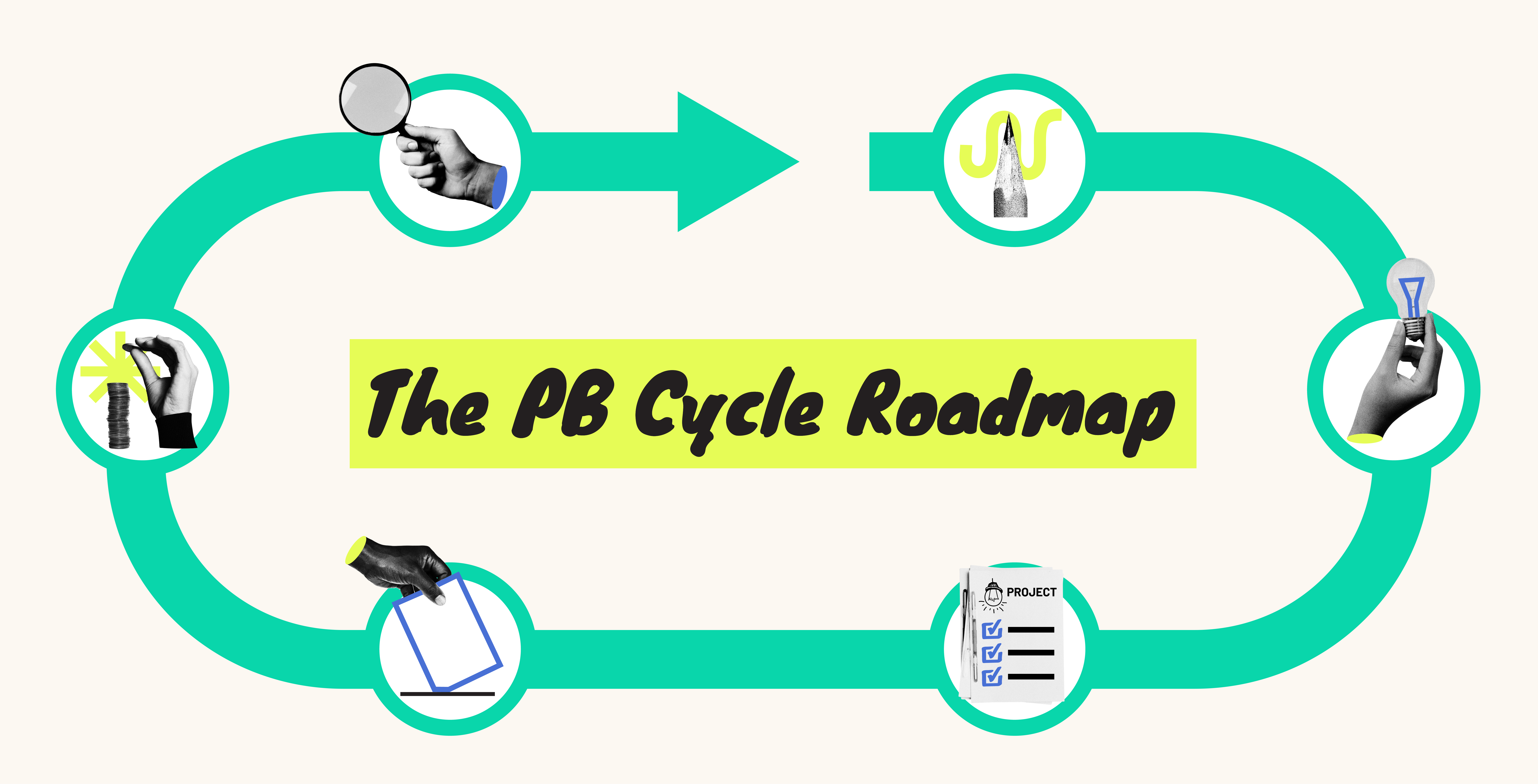
1. Design the Process
A Steering Committee that represents the community creates the rules that will guide the process.
2. Brainstorm Ideas
Community members discuss & share project ideas online through meetings & online tools.
3. Develop Proposals
Community members (Proposal Developers) turn ideas into feasible proposals.
4. Vote
Community members vote on the proposals that best serve the community’s needs.

5. Fund Winning Projects
Winning projects are funded & implemented.

6. Evaluate the Process
The process is evaluated to see if goals were met & identify changes for the next cycle.
After the vote, it’s important to evaluate the process - who participated, what worked well, and what could be improved for the next cycle. Winning ideas are then implemented, and the process begins again. Participatory Budgeting is a different way to make decisions, and ideally, it’s not just a one-time event but an ongoing cycle of direct democracy. Want to see Participatory Budgeting in practice? This introductory video shows you how it works.
History
PB can be traced to 1989 in Porto Alegre, Brazil where it began as a way to challenge corruption, and as an anti-poverty measure. The greater focus that residents gave to sanitation and public health when they were given the power to decide how their public dollars were spent, have been linked to reductions in the infant mortality rate 2
In addition, sewer and water connections went up from 75% of households when PB started to 98% by 1999. 3 Since its origins in Brazil, PB has been used in over 11,500 municipalities across the world. 4
What Kinds of Budgets Can Be Used for PB?
PB does not require a specialized budget- it can be done using a variety of budgets including:
- Jurisdictional budgets at the city, county, state, or federal level
- Non-governmental sources like foundations, or nonprofit budgets
- Discretionary funds for elected officials
- School, school district, or university budgets
- Public agency budgets
The type of budget used matters because each one can have its own rules, like what the money can pay for (which determines project eligibility), when it has to be spent (which shapes the timeline), and the steps required to release the funds (which can affect how projects get done).
In the United States, PB has increasingly been used with a specific focus. For example, in 2021, the New York Civic Engagement Commission used PB funds to support an equitable recovery from the pandemic, while the Phoenix Union High School District allocated PB funds to reimagine school safety without police on campus. For more information on types of budgets for PB and case studies showing how different budgets have been used for targeted purposes, visit pbcan.org.
About the Participatory Budgeting Project (PBP) And The Growth of PB In The United States
PBP launched with a vision to bring PB to North America and to support the first ever PB process in the United States, which took place in Chicago. We worked with local partners and an alderman to invest $1,000,000 in the 49th ward.
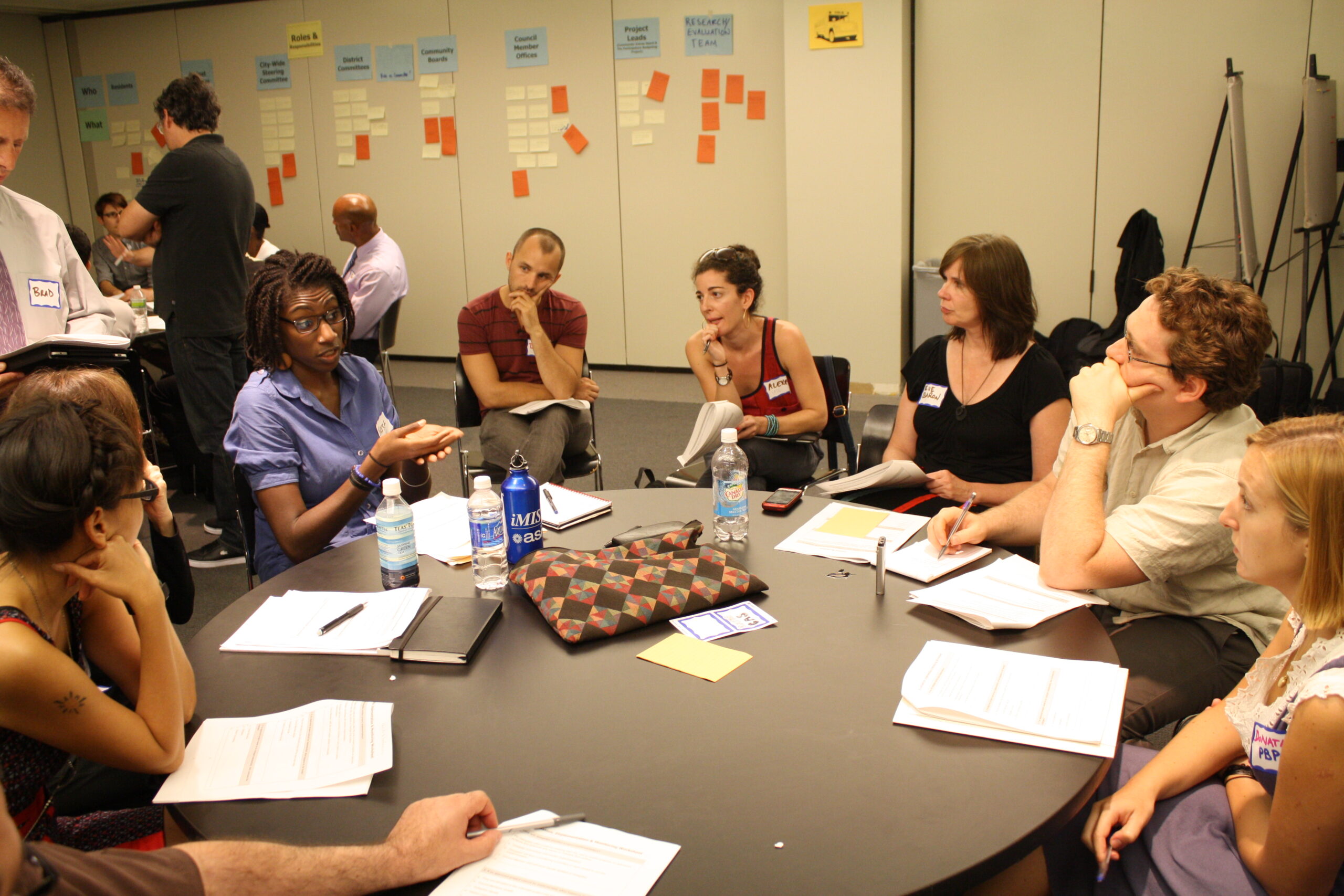
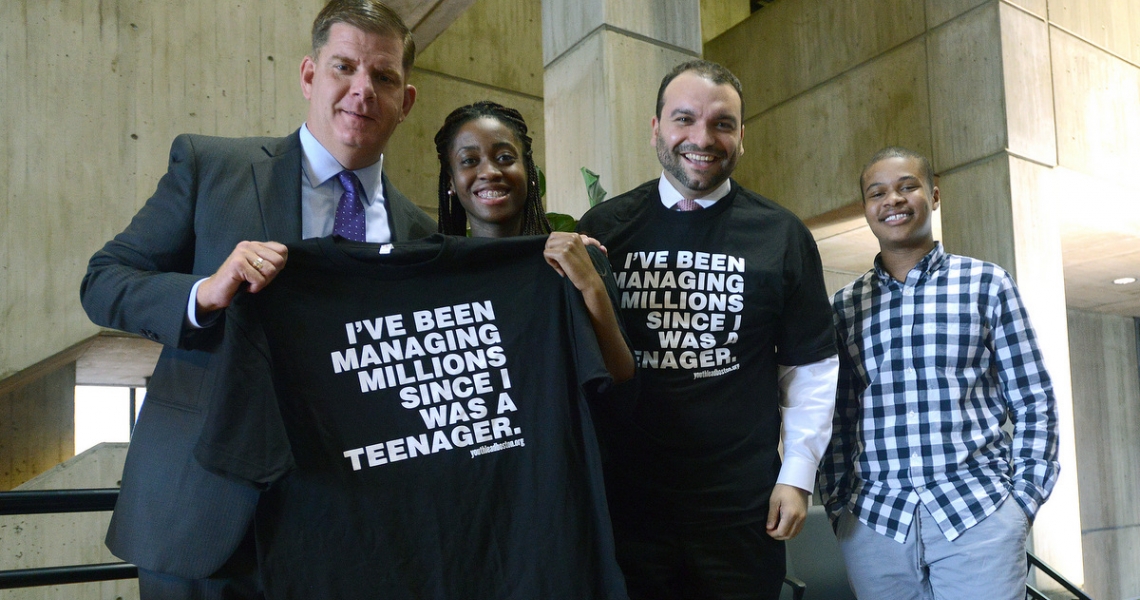
With the success of our work there, PBP worked to expand PB practice across the US and Canada, expanding to hundreds of processes over the next decade. These included the first ever process in New York City (PBNYC), which grew from a handful of districts to over 30, as well as Vallejo (the nation’s first citywide process), followed by Boston’s citywide youth-focused process. Since then, PB has become part of the fabric of many cities, for example, in New York City, voters approved a ballot initiative requiring PB to be held annually and managed by the Civic Engagement Commission, transforming it from an optional district program into a citywide mandate.
In the United States, PB has generally been used to foster equity in engagement, representation, and spending decisions. In Europe, the emphasis has often been on using PB as a tool for government transparency and accountability. More recently, Europe has also seen the growth of youth-specific processes and an increasing focus on participatory budgeting for climate justice.
We can see the different ways PB is implemented in both regions according to the focus they may have. With its focus on equity in the United States, we have seen PB processes formalize (paid) partnerships with community based organizations as a way to reach different segments of the population, as well as an increase in the number of processes that pay community members who are leading parts of the PB process. It is within this context and experience that this handbook has been written.
Elements For Successful PB
There are many factors that go into planning an impactful PB process. Below are some of the elements we think are important and emphasize throughout the handbook.
Money that Matters
Allocating a meaningful budget that is large enough to address issues that affect residents’ quality of life (such as a public health budget) helps ensure PB delivers impactful outcomes. Very small budgets, by contrast, make it difficult to meet community-identified needs, which can lead to frustration and reduce PB to a symbolic gesture rather than a truly transformative tool for democratic decision-making.

Grassroots Leadership
For PB to be meaningful, impactful, and inclusive, especially for those often excluded from decision-making, it must be driven by grassroots leadership. This means community members, organizations, and local groups should guide the process. PB naturally incorporates grassroots leadership through roles like Steering Committee membership, and implementing agencies can strengthen this by partnering with community organizations to lead outreach, idea collection, and voting events.

Inclusive Design
Ensuring broad participation in PB, especially for those who face multiple barriers, requires thoughtful planning with inclusivity in mind. Everything from the rules set by the Steering Committee (composed of community members) to outreach methods and the technology used to run the process should aim to remove barriers for as many people as possible. Including individuals with diverse experiences on your Steering Committee and conducting user testing for different parts of the PB process can help ensure it is designed to be truly inclusive.

Focused Outreach
Traditional elections show us that just because you invite people to participate, it does not mean they will show up. There are a multitude of reasons why this may be the case and those will vary according to the barriers different people experience. Being able to reach a variety of community members will require an intentional, focused outreach approach, and a budget to carry out that work.

Equity Criteria
Having criteria to use at different points of the PB process from planning to implementation is important to ensure representation from people who face barriers to participate. Having equity criteria will ultimately help make sure the PB process meets their needs.
Roles in PB
PB works best as a team effort. Internal staff, community members, and local organizations all play key roles. This collaboration expands reach, boosts participation, and gives residents real ownership of the process. Below you’ll see a bird’s eye view of the different internal and external roles different people play throughout the process.
Government / Institution
Implementing Agency: Implements the PB process & sets everyone collaborating up for success to help them perform their various roles.
Idea Vetting Team: Composed of different government agencies or departments (in the case of institutions implementing the PB process), this group reviews ideas submitted for basic feasibility and provides feedback on proposals during proposal development to help make them feasible.
Residents
Steering Committee: A diverse group of residents with different identities and lived experiences create the rules and engagement plan that will guide the process during the design phase. Throughout the process, they may work as a thought partner to the implementing agency to help maintain inclusivity and accessibility. They may also help conduct outreach.

Proposal Developers: Community members who select which ideas go on the ballot and turn them into feasible proposals. (Sometimes called Budget Delegates, but we prefer “Proposal Developers” because it’s easier to understand.)

Proposal Development Facilitators: Facilitate proposal development committee meetings and keep Proposal Developers on track.
Community Based Organizations (CBOs), Institutions, and Other Groups

Community Engagement Partners: CBOs, local groups, or institutions who engage the communities they serve in the PB process by conducting outreach, holding their own idea collection activities, and / or voting events.

Process Evaluators: Design and implement the evaluation approach to assess who participated and what can be learned for the next cycle. If funding is available, we recommend a third party independent of the implementing agency conduct the evaluation, especially for pilot processes.

Steering Committee
that represents the community designs the process.
Community Engagement Partners
engage their constituents in the PB process by conducting outreach to brainstorm ideas.
Proposal Developers
are communitymembers who refine idea ideas into feasible proposals.

Idea Vetting Staff
reviews ideas for basic feasibility & provide feedback on proposals to help make them feasible.
Implementing Agency
are responsible for getting the money out for the winning projects and overseeing their implementation.
Process Evaluators
assess outcomes, including participation and phases.
Contextualizing Your PB Process: Navigating Conflict
Before planning your PB process, it’s essential to recognize that it will unfold within an existing historical, political, and social context. While PB is an innovative tool for equitable decision-making, underlying tensions shaped by this context are likely to surface in your PB process. Understanding these dynamics and planning for them can help your team and community navigate conflicts in ways that cultivate progress and healing. Conducting a “landscape assessment” before you begin is a useful step.
Questions to Guide Your Landscape Assessment
- What is the current relationship between government, local groups, and community members?
- Is there a history of mistrust between residents and government? If so, how might people perceive this process or your staff?
- Are there community organizations that hold a high degree of trust?
- How has public investment been distributed across neighborhoods? Are there significant inequalities? Have communities been put in positions to compete for resources?
- What are the existing strengths of the community(ies)? What are people proud of? How might you cultivate that joy throughout the PB process?
These factors can really shape how the process plays out. For example, if there’s mistrust, it might be harder to recruit Steering Committee members or gather ideas, which can slow things down and even deepen that mistrust. Existing inequities can also influence big questions, like who gets to participate. That’s why it’s so important to approach these conversations with care, acknowledging the government’s role, honoring people’s lived experiences, and making sure the process doesn’t create more harm.
Beyond assessing the context and integrating it into your planning, you can strengthen your team’s ability to navigate difficult conversations by:
- Hiring skilled facilitators who understand your community’s history and dynamics, especially for Steering Committee meetings and idea collection conversations.
- Partnering with local organizations that serve historically marginalized communities, empowering them to facilitate their own idea collection discussions.
Now that you’ve got the big picture, you’re ready to start shaping a PB process that truly reflects your community. We’re here to guide you every step of the way. See you in the next chapter!