
Phase 3: Proposal Development
Supporting Community Priorities on the Ballot
Key Skills
- Planning
- Project Management
- Facilitation
- Training
At a Glance
After idea collection, you will be left with hundreds, if not thousands of ideas! Each one reflects the opportunities you created for community input
Now it’s time for Proposal Developers (sometimes called “Budget Delegates”) to work together and decide which ideas to research and turn into full proposals. This is the phase where community members collaborate most closely with the government or implementing entity.
Proposal development can be one of the hardest phases to wrap up on time because of the many moving parts. Developers will draw on community feedback, local knowledge, and institutional input to choose ideas that are both impactful and feasible. We recommend allowing at least three months for this phase so decisions are thoughtful and no one feels rushed.
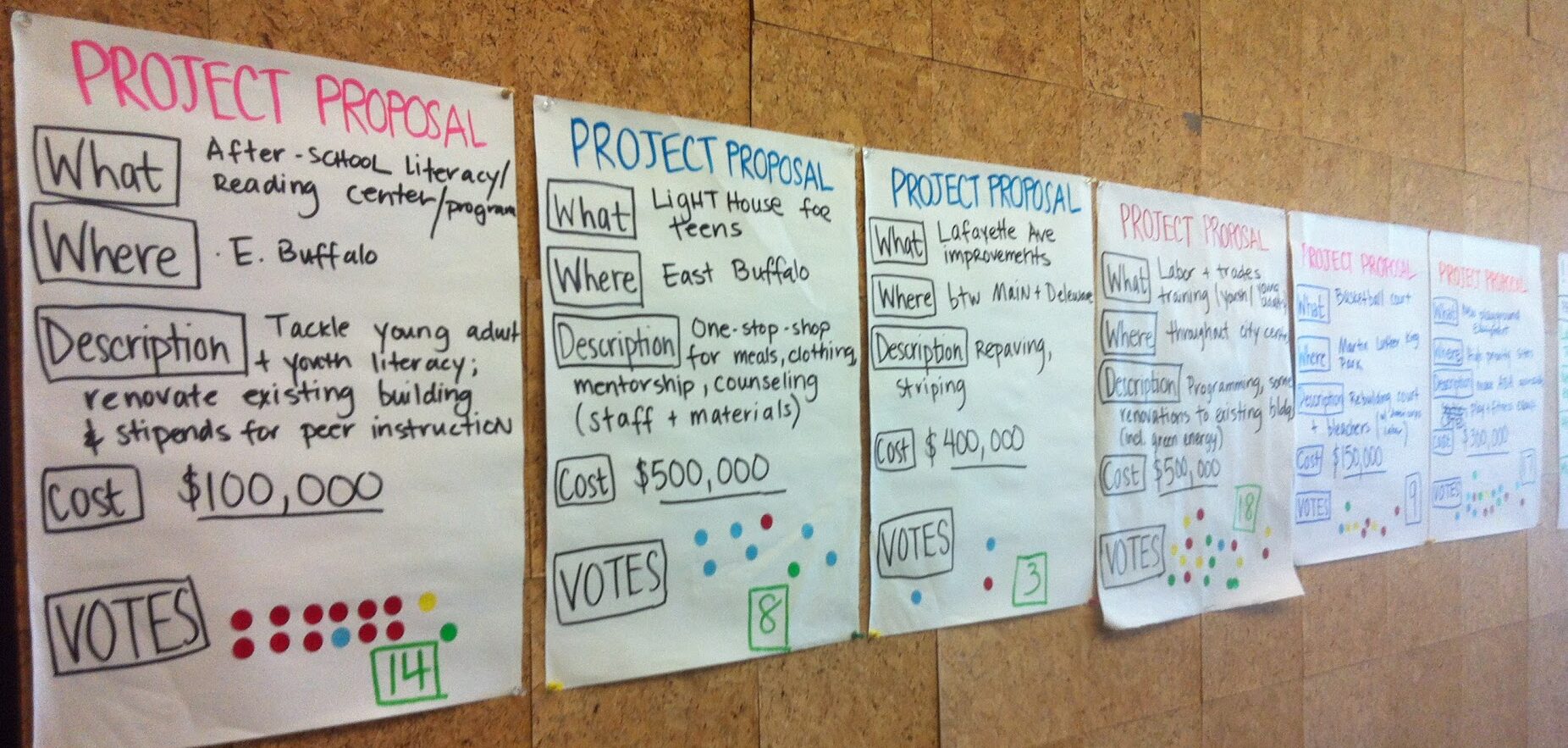
A successful proposal development process is measured by how well the final proposals reflect community needs and by the experience of Proposal Developers working with each other and with the government. Success depends on making it easy for developers to prioritize, research, and finalize proposals – and for facilitators to guide them. A clear workflow for vetting ideas and sharing information with Proposal Developers is equally important.
*Note: Participatory Budgeting, from its beginnings in Brazil, relied on Proposal Developers, (a team of residents who were not part of the government or institution implementing PB). Since then, Proposal Developers have been an integral part of ensuring PB is a community-driven process where resident needs (as stated by residents and not governments/institutions) are reflected on the final ballot.
Some PB processes have opted to use other structures to develop proposals due to various constraints or specific context–including when the process is focused on programs and services (instead of capital budgets that will produce proposals in the built environment). In these instances, local organizations may act as the Proposal Developers because of their expertise in the subject matter, or the fact that they are well positioned to run the program. For example, if there are a handful of organizations who already provide mental health programming, it makes sense for these organizations to develop the details of the proposal. They have an intimate understanding of their specific communities, current programs, and their gaps. They would also be well positioned to write a proposal that they can realistically implement.
The majority of PBP-supported processes have involved the traditional model, which focuses on working with individual residents (not organizations) to research ideas and turn them into concrete proposals. This is one the safest ways to ensure the PB process is community-led (as opposed to being run by local institutions). It also brings a wealth of opportunities for governments and institutions to learn from their residents, and for residents to learn about the programs, services, or projects already taking place. This chapter has been written according to that model. We recommend you read the rest of this chapter and later check out our ““Guide to Ensuring Proposal Development is Community-Driven if you are thinking of making a change to this part of the process.
Roles
*Government/ Institutional Staff
Support Proposal Developers & Committee Facilitators
- Identify ideas that are not feasible due to legal, jurisdictional, or budgetary conflicts
- Provide cost estimates & other implementation context for Proposal Developers
- Share budgetary and legal feedback on individual proposals to help make them feasible
**Proposal Developers (Also referred to as “Budget Delegates”)
Prioritize & develop project ideas, ensuring the community’s needs are reflected on the ballot
- Review ideas submitted by community members & assess them for need, impact, equity, & accessibility
- Conduct research to develop proposals
- Apply feedback from relevant departments to fulfill feasibility requirements and to finalize proposals
Proposal Development Committee Facilitators
Facilitate meetings & keep proposal developers on track
- Develop & share meeting agendas & notes
- Communicate information, news, & feedback provided by government staff to Proposal Developers
- Remind committee of upcoming deadlines
- Funnel questions from Proposal Developers to the implementing agency
Notes
*The entity implementing PB typically puts together a team of department staff that can provide feedback on the feasibility of ideas submitted – often referred to as the “Idea Vetting Team.” Before or during idea collection, the implementing entity would ideally select this team according to the project categories and their knowledge on feasibility.
**Although no prior experience is needed for this role, you will want to make sure you have representation from those most typically left out of traditional decision-making spaces. An interest in research and familiarity with the community, its neighborhoods, and resources is a helpful qualification.
Some processes on the other hand, build proposal development into the Steering Committee role, which reduces the capacity and demand for recruiting, selecting, and onboarding a new set of community members. For larger cities, this may not yield enough people to sort through a high number of ideas. Separating these roles may help reduce burnout for community members, and provide multiple ways to engage with the process. It also prevents any one group from wielding too much power.

GOALS
Onboard Proposal Developers and provide them with the tools they need to identify proposals that best reflect community needs.
Selecting which ideas move forward to the ballot can feel daunting, especially when there are hundreds or even thousands of submissions. Support them by offering effective training, a clear decision-making framework, and well-defined timelines. Summaries of idea collection or needs assessment conversations can help ground their choices in resident voices. You might also share relevant local statistics and examples of previously funded projects to guide prioritization.
Facilitate a collaborative relationship between the implementing agency, proposal developers and facilitators
Proposal Developers need to be well resourced to ensure residents have impactful proposals to vote on. They will need support and guidance throughout the process and have access to the following information:
- Ideas submitted: how feasible or realistic they are, what kind of impact they would have with the funds available, whether or not similar projects already exist or are in development.
- Their proposals: their estimated costs, implementation options and trade-offs, accessibility considerations, legal requirements, and so on.
The more you can bring in feedback from departments and agencies, the easier it will be to provide quick and detailed information across a range of project ideas and proposals. Having a strong collaboration workflow will ensure the final projects on the ballot are actionable and impactful. It will also provide meaningful opportunities for community members and government staff to learn from one another and build trust.
Facilitate a process that allows the ideas that Proposal Developers have selected to get approved
For PB to work as intended, it must be community-led. It is important for the various departments in your idea vetting team to understand that Proposal Developers will be the ones driving the selection process, and that their role is to provide feedback on budget, legal, or other implementation constraints.
It is important for the Idea Vetting Team to list their feedback on ideas, particularly the reasons why an idea might be ineligible for this particular process, and what it would take to make them eligible. The goal should be to provide as much information as possible for Proposal Developers (and the general public). In this way, it is not the government agencies or institutions deciding which ideas should be prioritized; rather, it is Proposal Developers using what was heard in idea collection conversations, their lived experiences, and relevant data to select the ideas. Agency feedback will help them craft feasible proposals.
The Six Steps of Proposal Development
Proposal development typically involves 6 steps. Steps 1-2 (Feasibility review & sorting ideas into categories) are typically led by the implementing agency while steps 3-6 are led by Proposal Developers.

Steps in Detail
1.
Feasibility Review
The implementing agency will conduct an initial review of all ideas submitted by community members and vet them for feasibility under the parameters of this particular participatory budgeting process. This takes place before proposal development officially begins.
2.
Sort Ideas Into Project Categories
The implementing agency will sort all ideas submitted by the community into project categories. These categories are typically thematic and/or can be aligned with the agencies or departments that are most likely to carry the project forward or whose topic fall in their purview.
If the implementing agency uses a PB tech platform, it may allow community members to categorize their ideas during submission. In that case, ideas will already be organized before proposal development begins. These categories often become the committees Proposal Developers join, so they only review and develop proposals within their category. This approach helps manage each developer’s workload.
Note: Earlier in this handbook, we talked about how needs assessments can help you understand what residents have identified as their top priorities. Needs assessments highlight the gaps between current conditions and community goals. You can share this data with Proposal Developers to help shape proposals that respond to the priorities heard in the needs assessment.
3.
Score Ideas
Working within committees (usually sorted by the categories that ideas fall into), proposal developers will score ideas within their project category using the Idea Scoring Tool.
The criteria used to score ideas in the idea scoring tool can be adapted to fit each particular PB process, which can be done with the Steering Committee and Proposal Developers. The tool typically uses a scale of 1 – 5 and will ask committees to rate each idea on: 1) need for the project; 2) impact of project; as well as 3) the project’s likely effect on equity and accessibility.
In this step, committee members deliberate over the scoring. Please review the Idea Scoring Tool to learn more about the criteria that Proposal Developers will use to rank ideas. Deliberation helps ensure diverse perspectives are considered, especially from community members who aren’t on the committee or who are often excluded from traditional decision-making.
4.
Prioritize Ideas to Move Forward
After committees deliberate over idea scoring, they will select ideas to research and develop within their category. The ideas that committees choose to move forward are the ones they will research to develop into full proposals.
This step will also naturally involve deliberation. Committee Facilitators will support Proposal Developers in this deliberation
5.
Research Priority Ideas
Committees research proposals they plan to move forward to design the details of the final version. For example, if a committee is exploring free mental health programming to fill gaps in services for immigrant communities, they might survey existing free or low-cost services in different neighborhoods and languages to find the best location for impact. They could also consult current providers to identify important considerations for implementation. For more guidance, see our Proposal Development Research Guide for examples of helpful research practices.
6.
Draft Proposals
After researching proposals, committees draft them, filling in key details such as:
- Proposal description: What the project aims to do, who it will serve, desired impact, and important parameters.
- Cost estimate
- Any implications for the Request for Proposal (RFP) process, which will be used to select organizations or companies to implement winning proposals.
See the Project Proposal Drafting Template for an overview of all required details. Collaboration between Proposal Developers and the implementing entity is crucial at this stage to confirm feasibility and ensure accurate cost estimates.
The proposal development process and materials provided here, such as the Idea Scoring Tool, illustrate how ideas progress into proposals. If you think another objective and transparent prioritization tool might work better in your context than the scoring process described in this chapter, you should use it! What’s essential is that the core steps – prioritization, selection, and proposal development happen in some form to turn a long list of ideas into a manageable set of proposals for community voting. Whenever possible, these steps should be led by the community rather than the implementing institution.
Planning
Ideally, preparation for proposal development starts well before this phase begins. This includes:
- Developing a timeline for proposal development
- Choosing the workflow community members will use to collaborate with the implementing entity
- Setting up the necessary infrastructure, such as spreadsheets, proposal templates, and platforms
- Recruiting proposal developers and the facilitators who will support them
- Preparing training materials for both groups
You should also have established touchpoints with the idea vetting team to ensure they understand their role in helping proposal developers confirm feasibility.
Needless to say, proposal development has a lot of moving parts! Below is a check-list of areas or tasks you should complete to plan an effective proposal development process.

Plan how you will track & sort ideas: Establish a database for all submitted ideas to be recorded in a standardized format. This database should allow you to sort all ideas submitted by the community into project categories, which could include categories such as “housing and homelessness”, “food security” or “transportation & mobility” among others. These categories are typically thematic and / or can be aligned with the agencies or departments that are most likely to have the responsibility to implement them or that fall in their purview. As mentioned earlier, if you are using a PB platform such as Decidim, ideas will already be sorted into categories that you will have pre selected.
Plan where and how your Idea Vetting Team will leave feedback for the initial idea review as well as on final proposal drafts: Plan where and how the Idea Vetting Team will give feedback, both during the initial feasibility review and on final proposal drafts.
A common setup is:
- The Idea Vetting Team records first-round feedback in a master spreadsheet.
- The implementing team shares a Proposal Developers spreadsheet that (a) pulls the vetting feedback into one tab and (b) provides a separate tab for ranking and developer notes.
Whatever tool or process you choose, aim for a single source of truth, clear permissions, and a simple process that lets Proposal Developers collaborate without version sprawl. You can use the Idea Ranking tool template as a starting point, and clarify the sequence of steps for the Idea Vetting Team and Proposal Developers.
Plan key proposal development deadlines. Your timeline should include:
- Deadline for the initial feasibility review of submitted ideas (Idea Vetting Team)
- Proposal Developers’ meeting schedule
- Deadline for final proposal draft review (Proposal Developers)
- Any opportunities for the public to give feedback on proposals
- Deadline for final feedback on proposals (Idea Vetting Team)
- Deadline to select Proposal Developers and their facilitators
- Training schedule for Proposal Development Committee facilitators
- Training schedule for the Idea Vetting Team (this can start during idea collection—earlier is better!)
After drafting your timeline, review these dates with staff from your Idea Vetting Team and other relevant departments. This helps avoid conflicts during busy periods and keeps everyone accountable to the proposal development schedule.
Plan the meeting schedule for Proposal Developers
Sample Proposal Development Meeting Schedule
Meeting #1 →
Orientation to Proposal Development Training
Meeting #2 →
Idea Scoring
Meeting #3 →
Idea Scoring (Continued)
Meeting #4 →
Select ideas to research & organize teams around those ideas
Meeting #5 →
Research ideas
Meeting #6 →
Research (Continued)
Meeting #7 →
Drafting
Meeting #8 →
Community Input & Feedback Session
Meeting #9 →
Drafting (Continued)
Meeting #10→
Review government or institution feedback
Meeting #11 →
Revision work time
Meeting #12 →
Second draft review and feedback
Meeting #13 →
Finalize proposals
Meeting #14 →
Debrief the proposal development process and discuss next steps to prepare for the vote
Establish processes to compensate Proposal Developers & Committee facilitators: We recommend compensating community members for the time they spend on proposal development. Establish the protocol you will use to collect their payment information, deadlines in which they will be paid, and how you will communicate that information.
Plan how you will communicate the status of ideas submitted to the general public: If you are using a PB Platform such as Decidim, there are features to communicate the status of an idea from start to finish. Once your Idea Vetting team has left feedback and Proposal Developers have prioritized which ideas they will be researching, communicate the status of each idea on the PB platform for the general public. If you are not using a PB platform, this may be more complicated, so communicating what will be happening during this phase will be important to build and maintain trust in the process.
Develop your training materials: Develop training materials for your Proposal Developers, Committee Facilitators, and Idea Vetting Team before launching proposal development. These materials may include:
Slide decks for training sessions
Idea tracking spreadsheets
Facilitation guides for Committee Facilitators
Summary of needs and idea collection findings
Community data relevant to project categories to support proposal development
Having these materials ready ensures that all participants are well-prepared and aligned for a smooth proposal development process.
Training
This is a training-heavy phase! You’ll be focusing on training and onboarding Proposal Developers, their committee facilitators, and your Idea Vetting Team. If possible, start training your Idea Vetting Team and Proposal Development Committee Facilitators at the end of idea collection. That way, they’ll be ready to go, and you can concentrate on onboarding your Proposal Developers (see the “Looking Ahead” section of the Idea Collection chapter). Spreading out training like this can help your team ease into the phase with fewer questions and less hands-on facilitation.
If you weren’t able to start earlier, that’s okay! It just means you’ll be training everyone at the same time. Keep reading to see the key areas to cover for each group, along with helpful resources for creating training materials.

Proposal Development Facilitator training & onboarding:
Proposal Development Committee Facilitators are typically residents, though in very small cities they may be government staff involved in implementing the PB process. Facilitators help keep Proposal Developers on track to meet deadlines and guide meetings where developers:
- Prioritize which ideas to research
- Conduct research on project ideas
- Draft the final proposals that will go on the ballot
Facilitators also serve as a bridge, communicating questions from Proposal Developers to your team and sharing relevant information and feedback from government departments with developers.
Their training and supporting materials should therefore cover all of the following elements:
General onboarding to the proposal development timeline with an emphasis on deadlines for proposal developers
Their role and the role of Proposal Developers: It should be clear that they are not making decisions over which ideas to move forward; rather, they are facilitating the process for Proposal Developers in scoring, prioritizing researching ideas, and writing proposals
Solid grounding on the protocol they will use to communicate questions from Proposal Developers and expectations on receiving answers to their questions
An overview of available resources to help inform decisions that Proposal Developers will make (examples may include summary of what was heard during idea collection and/or needs assessments, neighborhood statistics, or department funding priorities to give Proposal Developers an idea of what is already being funded, and the Proposal Development Research Guide). They should also have an overview of the Idea Ranking Tool Proposal Developers will use to score all ideas submitted. You should also include time for them to practice using the tool themselves.
Facilitation skills, tools, and techniques: Key skills include the ability to surface multiple perspectives (including those not in the room), active listening, being attentive to the needs of vulnerable communities and adapting facilitation accordingly, navigating conflict, and taking clear, accurate notes.
Materials to support their meeting facilitation such as template meeting agendas: You can use the Proposal Development Committee Facilitator Guide to help develop their training packet.
Overview of payment logistics: such as how they will be compensated, the dates in which they will receive payment, and any forms they may need to submit to receive payment.

Proposal Developer training & onboarding
You can use the Proposal Developer Guide to help you structure the training for Proposal Developers as well as their support materials. In general, the Proposal Developer training should include:
An overview of their role
The Steps of Proposal Development
General onboarding to the proposal development timeline with an emphasis on deadlines for proposal developers.
An overview of the Idea Ranking Tool: to help them understand how to rank ideas, they should get an overview of this tool during training and, if possible, practice scoring a few sample ideas.
An overview of the resources available to help them move through the proposal development steps (this can include a summary of what was heard during idea collection and / or needs assessment, neighborhood statistics, or department funding priorities to give Proposal Developers an idea of what is already being funded, as well as The Proposal Developer Guide (once adapted for your process).
Examples of what they may need to research: Provide examples of ideas and the type of research that is helpful to do to ensure the final proposal meets the community’s needs. Visit the Proposal Development Research Guide to incorporate some examples into the training.
Contact information for their Committee Facilitator
Overview of payment logistics: This includes how participants will be compensated, the dates they will receive payment, and any forms they may need to submit.

Idea Vetting Team Training
Your Idea Vetting team will be a crucial source of information for Proposal Developers, helping them to develop feasible proposals that can be implemented without facing budgetary, legal, or jurisdictional constraints. The following contents will be an important part of their training to set them up for success in supporting Proposal Developers:
Their role in the Proposal Development Process & Expectations: They should understand that their goal is to support community members in building feasible proposals – not to provide feedback on ideas or proposals based on their personal or departmental preferences. It is also important for them to understand that Proposal Developers will rely on them to answer proposal specific questions, and for knowledge about what is feasible or what community projects departments are currently working on.
A big part of building feasible proposals is to have accurate cost estimates, which Proposal Developers will rely on the Idea Vetting team to provide. Emphasizing this part of their role will set them up for success, as they can pre-empt the type of examples of projects their department has developed to support them in providing cost estimates for proposals.
If you will have Proposal Development meetings that you would like them to attend so they can meet with Proposal Developers, those should be highlighted as well as the purpose of those meetings.
General onboarding to the proposal development timeline with an emphasis on deadlines for providing feedback and answering questions. Grounding them in the timeline will help them understand how prompt a response is required for individual questions, and help them plan their PB workflows around their already busy schedules. Providing an estimate about the expected number of hours per week they might spend around key moments can be very helpful.
Though this will depend on the volume of ideas as well as the workflow you have set up, below is a sample chart that many cities have used in their PB processes.
Please review the Internal Idea Vetting Team Training to support you in onboarding your Idea Vetting Team.
Sample estimate number of hours the Idea Vetting Team might spend supporting the process
1st Feasibility Review
Medium (1 – 3 hours/week): Initial review of ideas to tag clearly ineligible or unfeasible ideas & clarify what it would take to help make them feasible.
Idea Ranking
High (2 -3 hours /week): Responses to Proposer Developer questions about needs addressed, anticipated impact, and feasibility of ideas. May include some Proposal Development Meeting attendance
Proposal Development
High (2-3 hours/week): Responses to Proposal Developer requests for information and feedback on project descriptions, costs, timelines, and impact. Some Proposal Developer meeting attendance
Share what’s happened so far in the PB process: including findings from idea collection or needs assessments and how many ideas were gathered in each category, to give context about community priorities. If you are using a pb platform and residents have left feedback on specific ideas, you may want to include that data in your spreadsheet and indicate where it can be found.
How they will review ideas: It is helpful to go over the tool you will use for them to leave feedback. In most instances, they will be working on a spreadsheet.
implementing
Each training and proposal development meeting will launch the steps of proposal development. Your planning will help you handle questions that arise, thanks to your prepared workflow and training materials. To bring your plan to life, keep clear communication between Proposal Developers, facilitators, and the Idea Vetting Team.
Don’t forget the public! Once ideas are vetted for feasibility and developers choose which ones to move forward, document the status of each idea (and explain why if it’s not moving forward). This transparency builds trust in the PB process.
If you use a PB platform like Decidim, you can mark each idea’s status and add comments. Without a platform, this is harder, but you could share a cleaned-up version of your idea vetting spreadsheets. If communicating the status of every idea isn’t possible during this busy time, you can share which ideas are being researched to be developed into full proposals.

Looking Ahead
Congrats on wrapping up proposal development! After proposals are finalized, ask developers if they’d like to help with the voting phase. Do they want to assist with outreach or present their proposals at voting events? Some may decline after investing significant time, but many will say “absolutely!” Involving them helps show that community members are leading the process and builds excitement for the vote.
Once this phase is complete, shift your focus to preparing for the vote. Take this opportunity to reconnect with your Steering Committee, review the outreach plan they created early on, and go over any key details for the voting process. For more guidance, see the Vote chapter.
- Design and format the ballot: Start planning your print and digital ballot early, focusing on accessibility.
- Plan for translations: Identify which languages you’ll translate ballots into by using demographic data and consulting your Community Engagement Partners and Steering Committee about the most spoken languages in their communities.
- Secure translators: Find reliable translators in advance, confirm their fees and timelines, and account for possible rush charges. Include this in your vote timeline and ensure translations are accurate to avoid errors on the ballot.

Resources
Guide to Ensuring Proposal Development Is Community Driven
If you are thinking of making changes to the proposal development process, we recommend you check out this guide to read about changes to the proposal development model we have outlined in this chapter and learn about the reasons why these changes were made as well as how to ensure that proposal development is still driven by the community (and not the government or institution implementing the PB process.)
Idea Scoring Tool
Use this Idea Scoring Tool template to develop your own for your own process to help Proposal Developers score ideas submitted in order to prioritize which will go to the ballot for a vote.
Proposal Drafting Template
Use this template to help Proposal Developers answer all the questions their final proposals should include for the ballot.
Proposal Developer Guide
Use this customizable Proposal Developer guide as an onboarding tool for your Proposal Developers to understand this phase of the process and how they will be turning ideas submitted into concrete proposals. You can also share this guide with Proposal Development Committee facilitators to help them understand the process they will be facilitating during their meetings.
Proposal Development Research Guide
This guide can be used as another onboarding tool for Proposal Developers to understand the type of research they can do to develop ideas into concrete proposals. You can also share this guide with Proposal Development Committee Facilitators.
Proposal Developer Training
This customizable slide-deck takes the guesswork out of structuring your Proposal Developer training. It contains all the important topics to cover in your onboarding initial training.
Proposal Development Committee Facilitator Training
Use this customizable slide-deck to make sure your Proposal Development Committee Facilitators have a strong understanding of their role and how they will be supporting Proposal Developers through the steps of the process.
Idea Vetting Team Training
Use this template slide deck to take the guesswork out designing your Idea Review Team training. Make sure to adapt it to include any specifics in your unique PB process.